1. Product & Industry Overview
With pickup access to cities liberalized, investment in this segment's production lines climbs — among the inquiries a pickup truck assembly line receives now, fuel-and-EV shared lines hold more than half, and flexible configuration has become the high-frequency phrase. The pickup truck assembly line (also called a pickup production line) covers final assembly from BIW on-line to whole-vehicle off-line; pickups are ladder-frame constructions, so chassis marriage differs from unibody car practice, with torque-heavy docking stations across powertrain, frame and cargo bed. The types: double-cab pickups serve family and business both, running the largest volumes; single-cab and one-and-a-half-cab models go to work and logistics duty; EV pickups carry battery packs along the frame sides or beneath, so the marriage station reserves insulation checks; long-bed and flat-bed variants follow regional markets. Quality control on a vehicle final assembly line sits in three places — door-marriage gap and flush, chassis-marriage torques, and the bed-to-frame fastening — the cargo-bed section being one a car line simply doesn't have.
2. Process Flow (see photo)
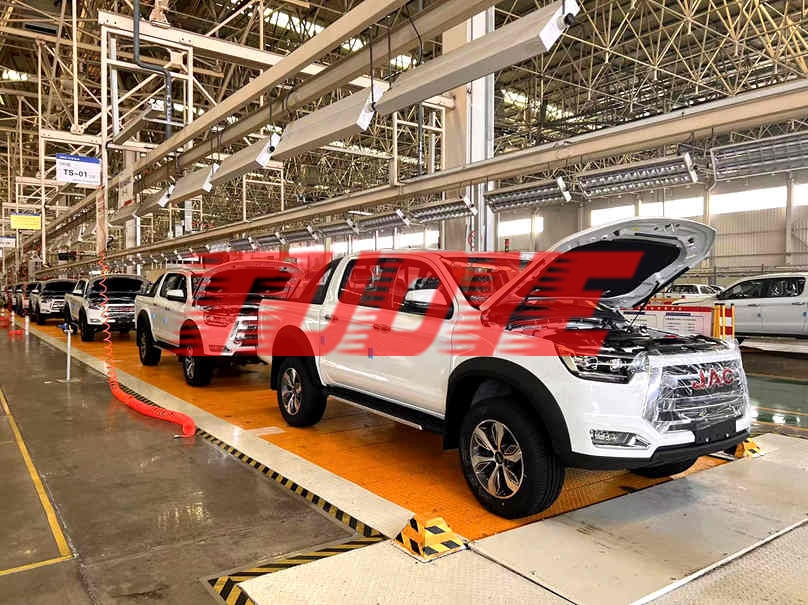
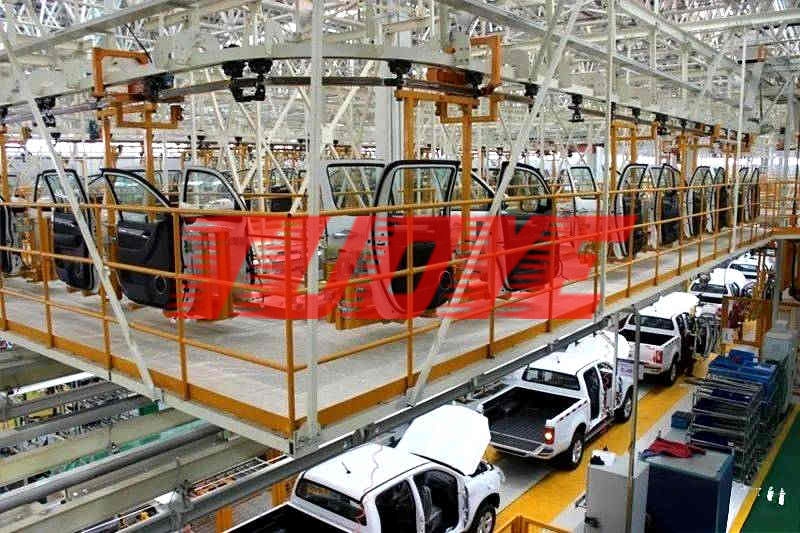
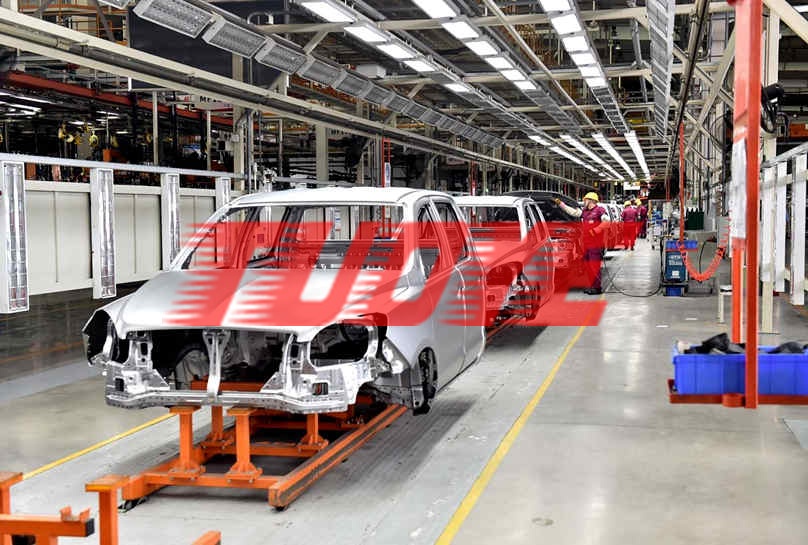
The photos show three sections of one pickup final assembly line. First: a two-tier layout — overhead chain carrying door assemblies (orange-yellow carriers with locating clamps) from sub-assembly to marriage stations, while below a bench-type line carries a white double-cab with hood open fitting front-bay parts, blue-and-white racks along the way. Second: the BIW section — orange skid benches holding painted bodies in queue at the head of the final line, workers in clean uniform on the floor. Third: the final trim section — yellow worktops with yellow-black hazard edging, a white pickup with appearance parts complete and hood open for front-bay checks, five-to-seven vehicles nose-to-tail awaiting off-line testing. Assembly sequence: BIW on line → trim-in (harness, headliner, carpet, windshield) → doors off for sub-assembly → chassis marriage (frame, powertrain, propeller shafts, brake lines) → door marriage → instrument panel and bumper → wheels and seats fitted → fluids and whole-vehicle tuning → wheel alignment, lamps, water test, off-line.
3. Customization & Service
Customization: skids and benches per vehicle platform with quick-change pin sets; door-chain carriers matched to door models; the test line configured to dual fuel/EV protocols. Tuoye — in Wenling, Taizhou, Zhejiang, China — designs the pickup truck assembly line around JPH, ships from in-plant pre-assembly and commissions through trial production, warranty one year, skids, carriers and chain parts supplied long-term; retrofits adding EV marriage stations to existing lines are experienced work. For a proposal and quotation, send platform, JPH and workshop conditions — line splitting and logistics organization come drawn together.
One efficiency detail on door marriage: sub-assembled doors board in body-number order, with coded recognition on the overhead carriers — the right door finds the right body, nothing reworks. Test-section configuration follows the sales markets: domestic models take alignment, lamps and water test; export models add lighting-homologation and OBD positions, and the pickup final assembly line reserves dual-protocol interfaces. Phased construction is the common pattern — phase one stations at half the target JPH with utilities built full-scale, phase two adds lines without stopping production; skid returns and body storage, the shared sections, are planned full-scale from phase one, so the vehicle final assembly line expands smoothly. Tuoye issues phased plans with equipment lists — the investment rhythm of the vehicle assembly line follows the program, and the budget falls into place.