
1. Product & Industry Overview
Washer plants never see small orders — volume starts at thousands of units a day, and everything rides on line cycle and test-section sizing. A washing machine assembly line strings cabinet, tub, drive, electronics and testing into one flow: pallets circulate, and the line never stops moving. The trade also calls it a washing machine production line; models split into two camps — impeller machines (twin-tub and automatic) are simple and fast-moving, while drum machines carry suspension systems and heater modules with longer labor; export, domestic and e-commerce batches often share one line, so pallets on an automatic washer production line are sized to the largest model and fitted with quick-change locating.
Quality on a washer line concentrates in two places: concentricity and sealing at tub marriage, and vibration-noise in spin. Factory testing follows GB 4706 appliance safety for withstand voltage, insulation and grounding, then adds water-fill leak checks and spin run tests — high-speed spin watched for vibration, noise and walking; fail that gate and the machine becomes a "dancer" in the customer's laundry room. Test stations on a washing machine production line must be sized to the cycle — testing always runs slower than assembly, an industry consensus; export orders add voltage-standard and nameplate checks, so the test zone must switch supply standards during mixed runs.
2. Process Flow (see photo)
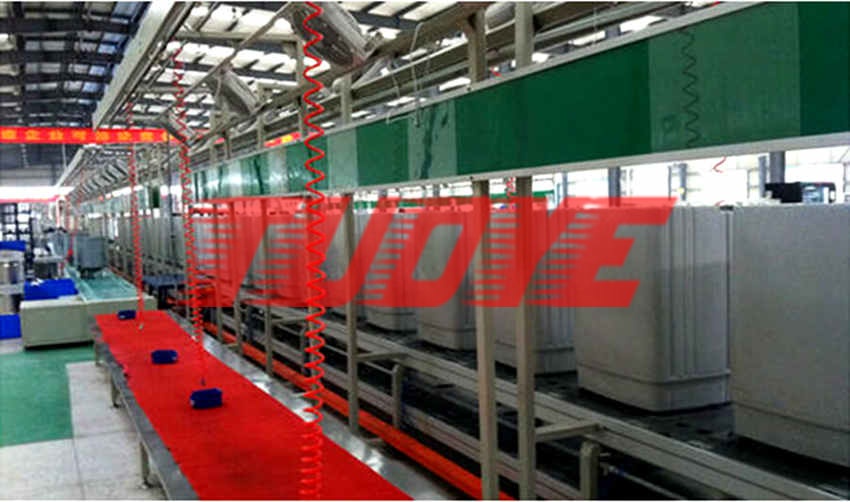
Look at the photo of this washing machine assembly line: a two-tier speedchain, white pallets on the upper tier at one cabinet per board, white locating blocks gripping the cabinet sides — stoppers park the pallet at each station and operators release it when done; the lower tier returns empty pallets, so boards circulate and the line never runs empty. The light-gray impeller cabinet in view has its top open and the tub dropping into place — the tub-marriage section; on the left, a red-topped bench is the static-check station with seated working and blue totes, green epoxy flooring carrying lane markings, the double-sided layout plain at a glance. Assembly sequence: cabinet on line → suspension hanging (rods for impeller machines, springs and dampers for drums) → inner and outer tub marriage → motor and clutch (or direct drive) → harness and hose connections → panel and control board → withstand/insulation/ground test → water-fill leak check → spin and run test → appearance check and packing. On a washer manufacturing line, the tub-marriage station gets an assist arm — hoisting tub assemblies by hand for a shift breaks both capacity and backs.
3. Customization & Service
The washing machine assembly line is configured to model, daily program and workshop: pallets located per model, static-check benches and test stations counted against the cycle, line length set by process flow. Tuoye, in Wenling, Taizhou, Zhejiang, China, delivers with in-plant pre-assembly and trial runs, commissions through trial production, warranty one year, pallet and chain parts supplied long-term; capacity expansions and added test sections on existing washer lines are taken too. For a quotation, send models and program.
Two notes for washer plants. First, isolate the foundation of the spin-test station — sharing one slab with other stations makes every vibration reading common-mode interference, and the numbers drift past any usable standard. Second, count stations backwards from JPH: 3,000 units a day on two shifts is roughly one unit every 19 seconds, and test stations deserve triple the cycle as buffer — on a washing machine production line the extra positions all get used in peak season, and the lines that skipped them stack up at the tail every single day of it.