Why Heavy Duty Matters in Commercial Vehicle Assembly: The Design Logic of a Truck Assembly Line
1. Product & Industry Overview
A commercial vehicle assembly line — the trade also says truck production line or truck assembly line — is the turnkey equipment for final assembly of cargo trucks, tractors, buses and special vehicles. The lines built by Tuoye in Wenling, Taizhou, Zhejiang, China are engineered for heavy duty and flexibility against the class's big curb weights, heavy parts and wide variant mix.
Industry-wise, commercial vehicles divide by tonnage and duty into heavy trucks (long-haul tractor and heavy haulage), medium trucks, light trucks (city distribution) and buses (transit and coach) plus special chassis. Compared with passenger cars, final assembly leans harder on the "main line plus sub-assembly lines" model: engine and gearbox join on a powertrain sub-assembly line while doors, instrument panels and frames pre-assemble separately, all feeding the main line for marriage; flow-line chassis assembly and mechanized body trim lines are the baseline capability for market entry. The new-energy wave adds battery-pack marriage and e-drive axle stations to the commercial vehicle assembly line.
2. Process Flow & Line Configuration (as shown)
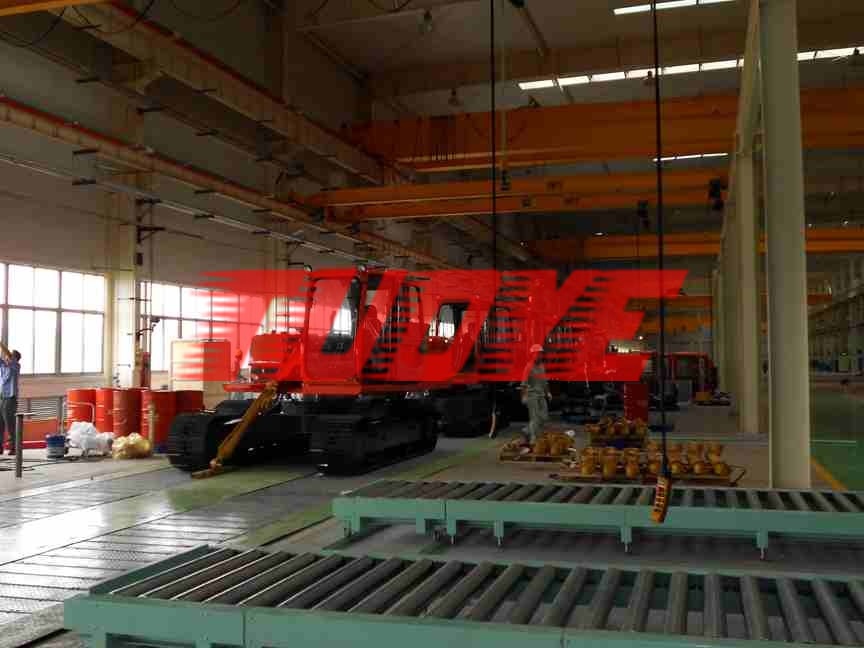
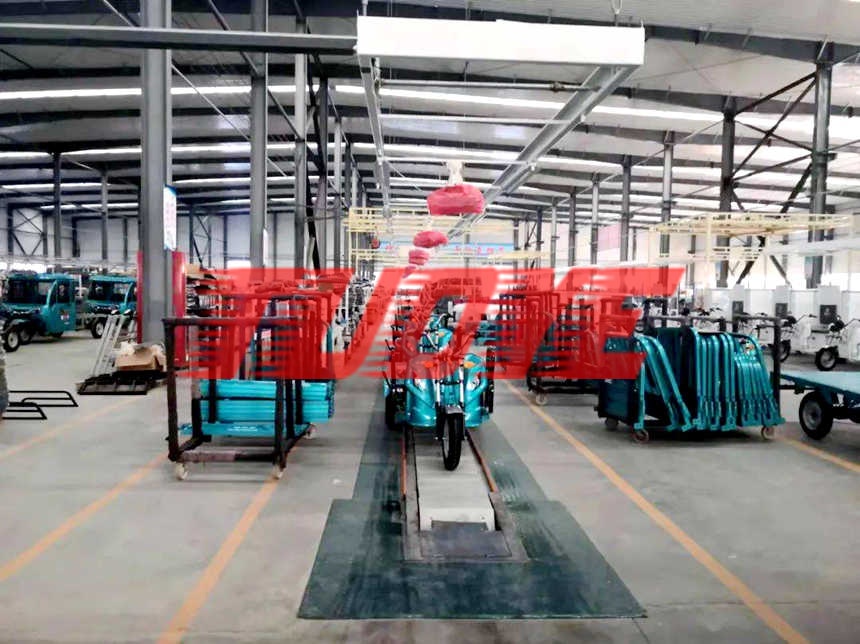
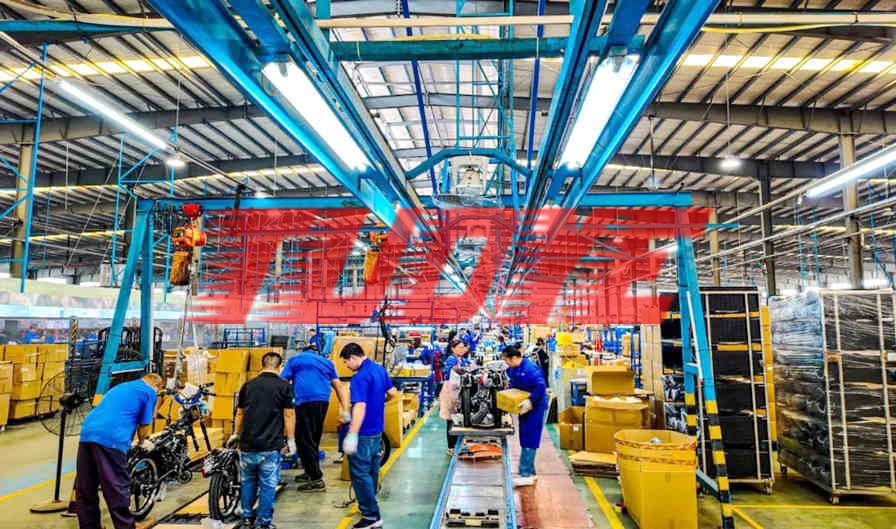
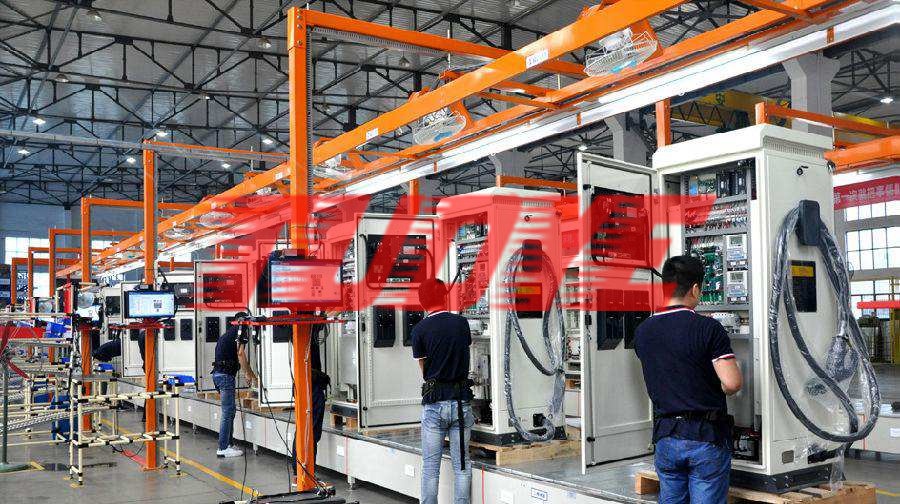
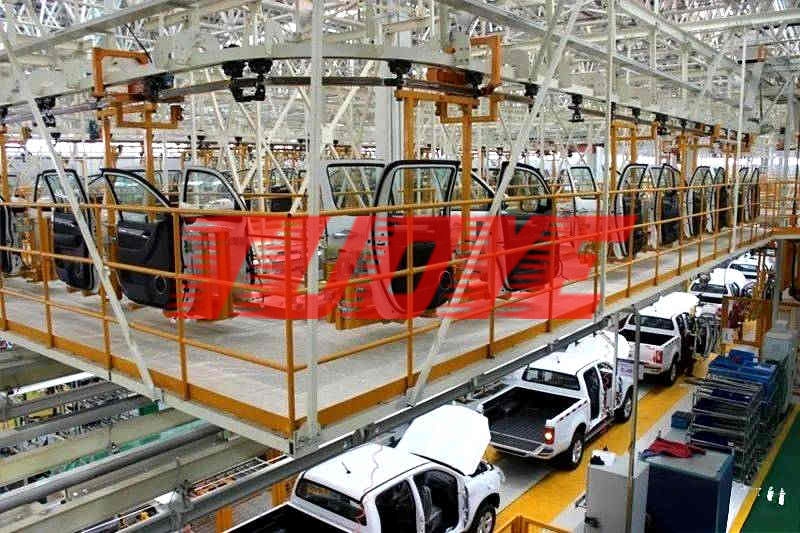
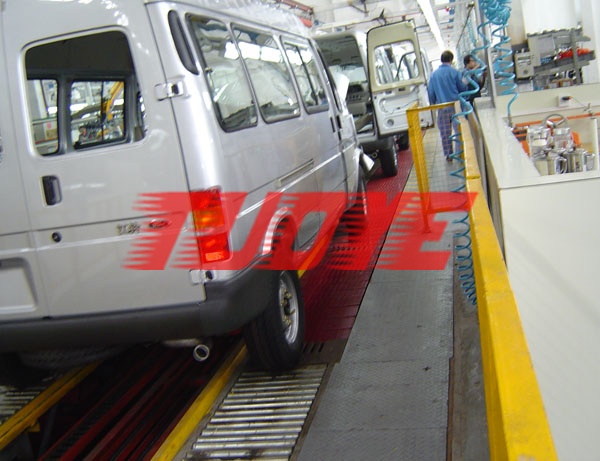
As shown, this case truck assembly line runs a red wide-deck plate chain: the wide chain carries cabs and frames flowing together, metal grating walkways and service platforms on both sides for high-level work; yellow guardrails run at working height, blue spiral air hoses feed suspended balancer tooling for zero-gravity tool handling; line-side racks replenish to the JIT beat, electrical cabinets control the line centrally, and the tail ramp lets vehicles drive off. Typical flow: frame on line → chassis upside-down build (powertrain, propeller shafts, axles, air and brake lines) → frame flip → cab marriage → trim and glass → wheels and cargo body/upper structure → fluids → interior/exterior inspection → test line (brakes, lamps, sideslip) → road test and off-line. On a commercial vehicle production line, beat and heavy-part logistics (delivery sequence, kitting order) decide line capacity, and line-side logistics lanes must be planned together with the stations.
3. Customization Options
The commercial vehicle assembly line is a non-standard turnkey project: chain width, loading and drive power rated to the vehicle types; flip machines, marriage hoists, torque-controlled tightening and filling equipment per process; sub-assembly lines, test lines and water-test lines planned as a whole; electrics integrable with ANDON, counting and beat display. From your vehicle range, JPH target and workshop conditions, Tuoye issues the complete proposal, section-wise equipment lists and quotation for a commercial vehicle assembly production line, with installation, commissioning and after-sales.
4. Delivery & Service
Turnkey delivery: early confirmation of the vehicle range (heavy, medium, light trucks, buses, special chassis), JPH target and workshop conditions, coordinating main lines, sub-assembly lines and line-side logistics into the general layout and section lists; equipment ships in batches after pre-assembly and loaded trial runs, is commissioned on site and accepted with trial vehicle production, maintenance crews trained. One-year machine warranty, long-term supply of chain plates, running gear, guardrails and drive spares, plus loading upgrades, beat improvements and NEV model-introduction retrofits. Building a new heavy-truck or light-truck assembly line — or speeding up the plate chain and expanding the marriage section on an existing commercial vehicle production line — Tuoye measures on site, quotes to the facts, and welcomes the conversation.
Permanent link: https://www.liushuixian.com/post/why-heavy-duty-matters-in-commercial-vehicle-assembly-the-design-logic-of-a-truck-assembly-line.html
Disclaimer: Some articles on this site are compiled from public technical sources for reference. If any content infringes your rights, please contact us for removal. Please credit the source when reprinting.